Gated communities across South Florida are collecting more visitor data than ever before, and boards are starting to ask the right questions. What happens to that driver's license scan after the guard waves someone through? How long is it stored, and who can access it? These are fair concerns, and they deserve straight answers. Contact Entrance IQ at (561) 503-4500 to find out how your community can collect visitor data responsibly while staying fully compliant.
The short answer is this: if your community doesn't have a documented data privacy policy tied to your visitor management system, you're exposed. Not just legally, but reputationally.
What Privacy Laws Apply to Florida Gated Communities in 2026?
Florida's data privacy rules tightened significantly when the Florida Digital Bill of Rights took effect in July 2024. For gated communities, this means any personal information collected at the gate, including names, vehicle plates, and DL scans, may qualify as "personal data" under the law if your community serves over a certain population threshold.
Here's what boards need to know in practical terms:
- Data minimization is now a legal expectation, not just a best practice. You should only collect what you actually need to verify a visitor's identity.
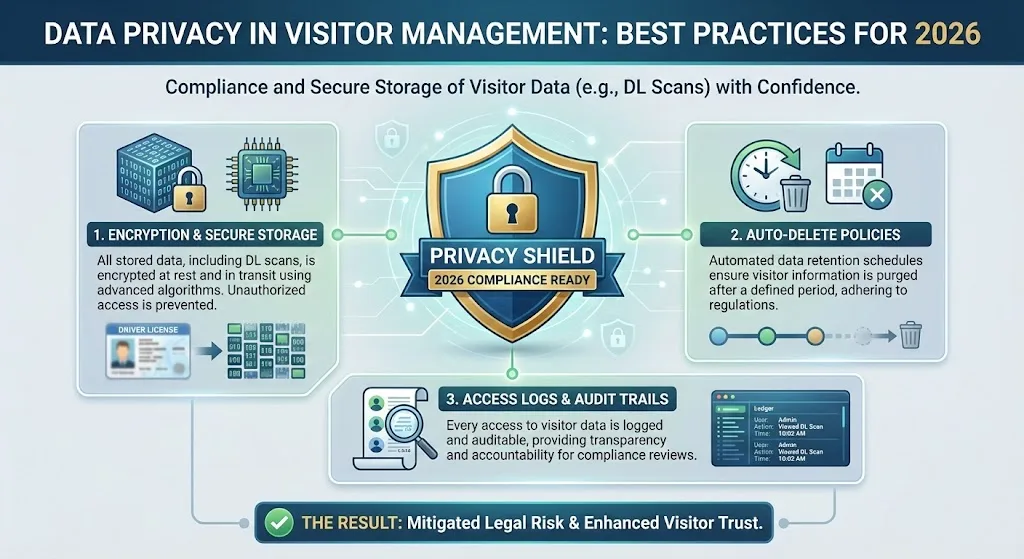
- Retention limits matter. Keeping DL scan data indefinitely creates liability. Most legal advisors recommend a 30-to-90-day retention window for standard visitor logs, with automatic deletion built into your system.
- Residents have rights. Under Florida law, residents can request to know what data has been collected about their guests and ask for its deletion.
Communities in areas like Palm Beach County and Broward County have seen an uptick in HOA disputes tied specifically to visitor data practices in the past 18 months. If your board doesn't have a written policy, now is the time to draft one.
What Are the Core Pillars of Secure Visitor Management?
Secure visitor management for a gated community rests on three core principles: transparency, data minimization, and purpose limitation. Each one directly reduces your board's legal exposure.
Transparency means residents and visitors know what data is being collected and why. A simple notice posted at the gatehouse and included in your welcome packet covers this requirement. It doesn't need to be lengthy.
Data minimization means your gated community visitor software only captures what's necessary. A first name, last name, vehicle description, and entry time are typically sufficient for most residential visits. Full DL scans may be appropriate for contractor access but shouldn't be the default for every guest.
Purpose limitation means the data collected at the gate is used only for gate access, not shared with third parties, used for marketing, or retained for unrelated purposes. This is where many communities unknowingly create problems.
We work with boards throughout South Florida and, in our experience, the communities that clearly define these three pillars in writing have far fewer disputes and a much smoother path when compliance questions arise.
How Should You Protect Physical and Digital Visitor Data?
Protecting visitor data at a gated community involves both what happens at the kiosk and what happens in the cloud.
At the gate: Lobby kiosks and guard stations should be positioned so that screens aren't visible to other visitors in line. Any printed visitor logs should be stored in a locked cabinet and shredded after the retention period. If your guard uses a tablet or shared device, access should require a PIN or login. Shared passwords are a common problem we see in communities around Boca Raton and the Palm Beach Gardens area.
In the cloud: Your gated community visitor software should store data on encrypted servers with role-based access controls. That means your gate guard can look up an approved visitor list but can't export the entire database. Ask your software provider specifically whether data is encrypted at rest and in transit. If they can't answer that clearly, that's a red flag.
For DL scans specifically: This is where boards need to be most careful. A scanned driver's license contains a significant amount of personal information: full legal name, address, date of birth, and ID number. Unless your community has a specific and documented reason to capture this data, such as contractor vetting or high-security zones, storing DL scans for routine visitor entry creates unnecessary risk. A 30-day auto-deletion cycle for scan data is a reasonable and defensible standard.
Does Your Visitor Management System Demonstrate Real Security Expertise?
This is a question worth asking your current vendor directly. Any system your board relies on for visitor management should be able to provide documentation on its security certifications, data handling policies, and breach notification procedures.
Entrance IQ was built specifically for gated communities and condo associations. The platform's design reflects a genuine understanding of how South Florida communities operate, including the needs of residents aged 55 and older who may interact with the system differently than younger users. That's not a generic claim; it's reflected in how the interface works.
A visitor management system that builds trust with your resident base needs to do more than just log entries. It needs to give residents confidence that their guests' information is handled responsibly. That confidence comes from choosing a platform with a track record, clear data policies, and local support.
How Do You Balance Easy Entry With Strong Privacy Protocols?
Modern gated community visitor software can handle both goals at once. You don't have to choose between a smooth entry experience and proper data protection.
Here's what that looks like in practice:
- Pre-registered guests can be approved by residents through a resident portal before they arrive, reducing the amount of data captured at the gate.
- QR code entry allows verified visitors to enter without requiring guards to handle or store any ID documents.
- Time-limited access passes expire automatically, which means the data tied to them can also be purged on a set schedule.
- Audit logs track who accessed visitor records and when, which is valuable if a dispute ever arises.
Communities in master-planned developments, similar to those found along the A1A corridor or in western Palm Beach County, often serve hundreds of unique visitors each week. Without the right system, managing that volume while staying compliant is genuinely difficult. The right platform makes it manageable.
Ready to Protect Your Community's Visitor Data?
Data privacy in visitor management isn't a future concern for Florida boards. The legal standards are in place now, resident expectations are rising, and the cost of getting it wrong, both in legal fees and community trust, far outweighs the cost of getting it right.
Boards that take the time to review their current practices, update their retention policies, and choose a gated community visitor software built for compliance will be in a much stronger position heading into 2027 and beyond. Those that don't are carrying unnecessary risk with every single visitor log they store.
Contact Entrance IQ today at (561) 503-4500 to talk through your community's specific situation and find out how their visitor management platform can help you stay secure and compliant.