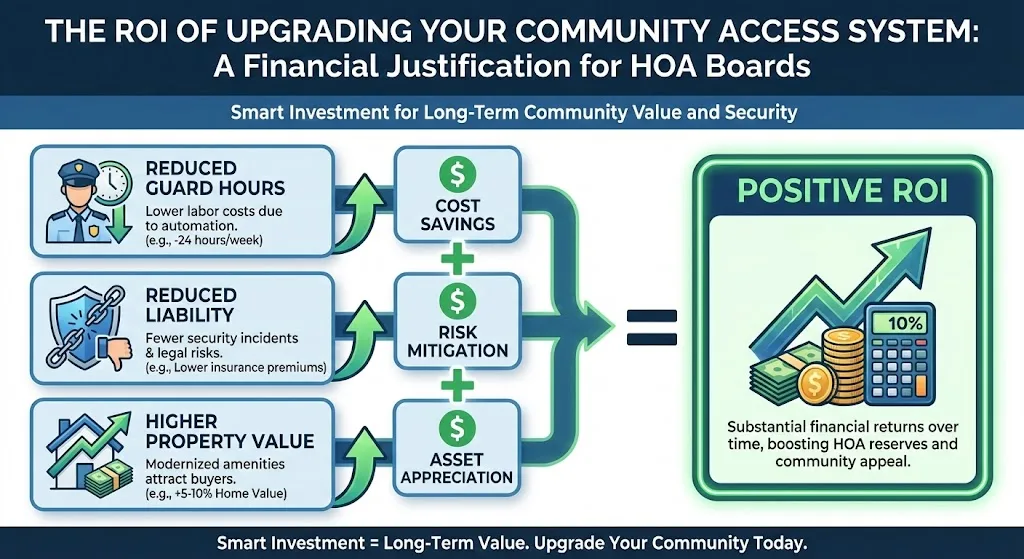
Outdated gate and access systems are costing Florida HOAs more than most boards realize. Across communities in Palm Beach County and throughout South Florida, aging keypads, paper logbooks, and broken intercoms quietly drain budgets, frustrate residents, and leave security gaps that could lead to real liability. If your HOA hasn't evaluated its access infrastructure in the last five years, it's time to take a hard look at what that delay is actually costing you.
Ready to see what a modern system could do for your community? Call Entrance IQ at (561) 503-4500 for a free quote.
What Does an Outdated Access System Actually Cost Your HOA?
The hidden costs of an aging system add up fast. Most communities don't track them as a line item, but they show up in other places: overtime for gate attendants, emergency repair calls, increased insurance premiums, and resident turnover driven by frustration.
Here's a realistic breakdown:
- Gate hardware repairs in Florida's salt-air coastal environment often run $800 to $2,500 per incident, and aging systems typically need repairs two to three times per year
- Manual visitor logbooks require staff time that, across a 250-unit community, can add up to 15 to 20 administrative hours per week
- Security incidents tied to access failures can push liability claims into the tens of thousands of dollars
- Resident dissatisfaction with poor guest management processes is one of the top three reasons residents cite when leaving 55+ communities
Modern cloud-based platforms like EntranceIQ address all of these cost centers in one system.
How Does a Modern Access System Increase Property Values?
Cloud-based access control raises property values in 55+ communities by 3% to 7% on average, according to HOA industry data. Buyers shopping in communities like Valencia Reserve or Broken Sound in Palm Beach County consistently rank security and ease of access among their top three priorities.
Curb appeal isn't only about landscaping. When prospective residents or their families pull up to a gate with a clean digital interface, a functioning intercom, and a quick entry process, that first impression matters. Contrast that with a faded keypad, a paper log, and a long wait while a guard manually processes a visitor. The difference shapes buying decisions.
A modern system also signals to insurance carriers and future buyers that the HOA manages its assets responsibly. That perception translates directly into long-term resale value for every homeowner in the community.
Can Automation Really Cut Down on Administrative Work?
Yes, and the time savings are significant. Communities that switch to automated visitor management systems typically reduce front-gate administrative overhead by 40% to 60% within the first three months.
Here's what that looks like in practice. Before automation, a gate attendant manually logs every visitor, calls the resident to confirm, and records departure times. In a busy 300-unit community, that process takes two to four minutes per visitor. Multiply that across 80 to 120 daily visitors and you're looking at three to eight hours of pure administrative time every single day.
With a platform like EntranceIQ, residents pre-clear guests through a smartphone app or web portal. The system handles verification automatically. The attendant's role shifts from data entry to actual security monitoring. That's a better use of staff time and a direct reduction in labor costs.
Remote credentialing is another major efficiency gain. Administrators can issue, modify, or revoke access permissions from anywhere, without printing badges or reprogramming physical keypads. For communities with part-time management staff, that flexibility alone is worth the upgrade cost.
Does Better Access Control Actually Reduce Insurance Costs?
A well-documented access system can lower HOA insurance premiums by 10% to 20%, depending on your carrier and the scope of your current coverage. The key is having verifiable, real-time audit trails.
When an incident occurs at a gate or common area, the first question your insurer asks is: what do your records show? Paper logs don't hold up well. A cloud-based system with timestamped entry and exit records, integrated camera feeds, and automatic alerts creates the kind of documentation that both deters incidents and protects the HOA when claims arise.
Integrated surveillance tied to your access system means every entry event has a visual record. That's a strong deterrent for opportunistic crime, and it's evidence your legal team can use if a dispute goes to litigation. For communities managing amenities like pools, tennis courts, and clubhouses, that audit trail extends across every access point in the property.
What's the Resident Experience Worth to Your Community?
In 55+ communities, convenience isn't a luxury. It's a retention driver. Residents who feel that guest management is easy and that their community is secure are significantly more likely to renew, refer neighbors, and participate in HOA governance.
Smartphone-based access means residents can let in a grandchild, a home health aide, or a repair technician with a few taps. No phone tag with the gate. No confusion over temporary codes. No waiting for a guard to manually process an entry request.
Guest pre-clearance through a resident portal is one of the most requested features we see from 55+ communities across South Florida. When families visit for weeks at a time, especially around the holidays, a clunky guest management process creates real friction. A system that handles those requests automatically, with confirmation sent directly to the resident's phone, removes that friction entirely.
Amenity management follows the same logic. Residents can book the pool pavilion or the fitness center through the same platform, with access automatically granted for their reserved time slot. No keys to lose. No paperwork to file.
How Does Florida's Climate Affect Your Access Hardware Choices?
Florida's environment is hard on outdoor hardware. Salt air along the coast causes metal components to corrode two to three times faster than in inland locations. Communities in areas near the Intracoastal Waterway or Boca Raton's coastal corridors see this accelerate even further.
When evaluating access hardware for a Florida community, look for:
- Powder-coated or marine-grade stainless steel on all exterior components
- IP65 or higher weather ratings on cameras and intercom units
- Cellular backup connectivity so the system stays online during power outages
- Storm-ready battery backup rated for at least 24 hours of operation
We've seen communities install systems without these specs and spend $1,500 to $3,000 per year on weather-related hardware replacements. The right hardware costs more upfront, typically 15% to 25% more than standard commercial-grade equipment, but the five-year total cost of ownership is substantially lower.
Florida's hurricane season runs June through November. A system that goes offline during a storm, when unauthorized entry risk is highest, isn't providing real security. Storm-ready backup power isn't optional here. It's a basic requirement.
How Do You Calculate ROI for Your Specific Community?
The ROI of a modern access system varies by community size, current infrastructure, and the specific features you implement. That said, most Florida HOAs recover their full upgrade investment within 18 to 36 months.
Start by adding up your current annual costs:
- Gate staff labor: Total annual hours spent on manual visitor processing x hourly rate
- Hardware maintenance: Repair and replacement costs over the last three years, divided by three
- Administrative overhead: Staff time spent on access credentialing, badge printing, and record keeping
- Incident costs: Any security-related claims, legal fees, or settlements in the last five years
Then compare that total against the annual cost of a cloud-based system. For most communities of 200 to 500 units, that system costs between $600 and $1,800 per month, depending on features and the number of access points.
The math usually tells a clear story. A community spending $8,000 per year on gate hardware repairs, $15,000 in administrative labor tied to manual guest management, and carrying a $5,000 insurance surcharge for insufficient audit documentation is already paying more than most upgrade packages cost annually.
Ready to Find Out What Upgrading Would Cost Your Community?
The best way to calculate your specific ROI is to talk through your community's current setup with someone who knows Florida HOA access systems. Every community is different, and the right solution for a 150-unit Delray Beach community may look different from what a 600-unit Palm Beach Gardens development needs.
Entrance IQ specializes in access control and visitor management for Florida residential communities, with particular expertise in 55+ HOAs across Palm Beach County. Call us at (561) 503-4500 to request a free quote and get a clear picture of what a modern system would cost and save your community.