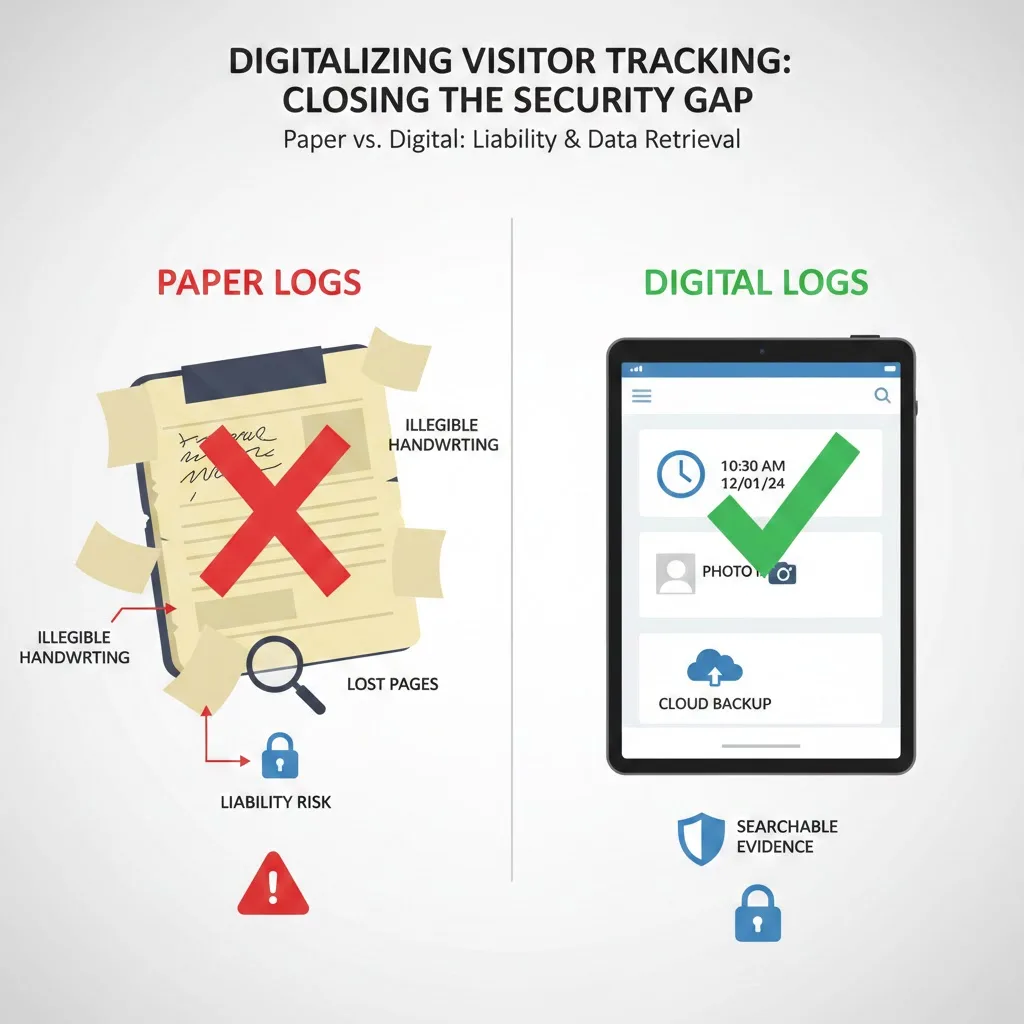
Paper sign-in binders were fine 20 years ago. Today, they're a liability. Florida commercial properties and gated communities are switching to digital visitor management systems fast, and the reasons go beyond just convenience. Ready to see what your paper log is really costing you? Contact Entrance IQ at (561) 503-4500 to find out how easy the switch can be.
Why Are Paper Visitor Logs a Security Liability?
Paper logs create real, documentable risk for your property. Anyone who walks up to the front desk can read every name, arrival time, and company written above them. There's no audit trail, no timestamp verification, and no way to confirm that the name in the log matches the person who actually entered.
From a legal standpoint, that's a problem. If an incident occurs on your property and investigators request visitor records, a handwritten binder with smudged entries and missing dates won't hold up the way a digital log will. Digital records are searchable, timestamped, and exportable. Paper records are not.
We've seen this scenario play out more than once: a property manager at a South Florida commercial office can't produce a reliable visitor record after a break-in because the log was incomplete, entries were illegible, or the binder had simply gone missing. That's not a documentation problem. That's a liability problem.
Privacy is another issue that's easy to overlook. Florida properties that host sensitive business visitors, medical staff, or legal professionals have an obligation to protect that information. A paper log sitting open on a front desk exposes visitor names to every person who walks through the door. Digital systems store that data securely, accessible only to authorized personnel.
What Does a Digital Visitor Management System Actually Do?
A digital visitor management system replaces the paper log with a tablet-based or web-based check-in process that captures visitor data in real time. Visitors enter their name, ID, and purpose of visit. The system timestamps the entry, notifies the relevant host, and stores the record automatically.
For gated community visitor management, this means guard gate staff can verify a visitor's identity against a pre-approved list in seconds rather than flipping through handwritten pages. Residents can pre-authorize guests from their phones. Delivery drivers get logged and tracked without slowing down the entry lane. Every record is stored securely in the cloud and can be retrieved in under 60 seconds if needed.
The difference in speed is significant. Manual check-in at a busy gate can take 2 to 4 minutes per vehicle. Digital check-in, with pre-authorization, typically takes under 30 seconds. During peak hours at larger Florida communities, that gap adds up fast.
How Does Digitalization Improve Site Security in Florida?
Digital visitor systems give security personnel tools that paper simply can't match. Real-time alerts notify staff when a flagged visitor attempts entry. Access logs show exactly who entered, when, and which gate they used. If a vehicle is on a watchlist, the system flags it immediately.
For communities near high-traffic Florida corridors, like those along US-1 in Palm Beach County or near major commercial districts in Broward, this level of control matters. Guard gate staff aren't just checking names anymore. They're operating a verified access control system backed by data.
Entrance IQ's visitor management platform gives guard gate operators a clear dashboard that shows all active and historical visitor activity. Staff can search by name, date, vehicle type, or unit number. That kind of retrieval speed is what makes digital records genuinely useful as evidence, not just documentation.
Does Florida Have Specific Compliance Requirements for Visitor Logs?
Florida commercial properties and residential communities aren't always required by state law to maintain digital visitor logs, but local building codes, HOA regulations, and liability standards are pushing strongly in that direction.
Many Florida counties now reference digital access control standards in their commercial building guidelines. Properties that handle sensitive data, operate in regulated industries, or manage large resident populations face growing pressure from insurers and HOAs to move away from manual processes. Some insurance providers are beginning to offer reduced premiums for properties with verified digital access control systems, with discounts ranging from 5% to 15% depending on coverage type.
Gated community visitor management that meets modern security standards also helps communities demonstrate due diligence if a liability claim is ever filed. A digital log with a verified timestamp and a photo capture is a far stronger piece of evidence than a handwritten entry with no verification attached.
How Does Digital Check-In Affect the Visitor Experience?
First impressions count, especially for professional office parks and high-end Florida residential communities. A guard handing a visitor a pen and paper to fill out a torn binder page doesn't project the image most properties are aiming for.
Digital check-in systems give visitors a fast, professional experience. Many systems send an automatic confirmation to the host, so the visitor isn't left waiting at the gate while a guard calls up to the office. Pre-registered guests get through in seconds. That kind of experience reflects well on the property and on the businesses or communities operating within it.
For gated communities in areas like Boca Raton or Palm Beach Gardens, where property values and resident expectations are high, the front gate is often the first thing guests see. A polished, digital check-in process signals that the community takes both security and professionalism seriously.
Is Your System Ready for AI-Driven Access Management?
The next generation of visitor management is already here. AI-powered platforms can recognize license plates, flag repeat visitors, predict peak entry times, and generate reports automatically. Communities and properties that are still running paper logs today will face a significantly steeper transition when they're ready to catch up.
Starting with a digital visitor system now puts you in a much better position to integrate those capabilities over the next 12 to 24 months. Entrance IQ is built with that flexibility in mind, designed to grow with your property rather than require a full replacement when your needs change.
Most gated community visitor management platforms take between two and five business days to deploy, depending on the size of the community and the number of entry points. Staff training typically runs three to four hours. That's a small investment for a system that works every day.
Make the Switch Before You Need To
Paper logs don't fail slowly. They fail the moment you actually need them, during an incident, a legal dispute, or an insurance audit. Digital visitor tracking gives your security team reliable records, faster entry processing, and a system that holds up when it counts.
Properties across Florida are making this switch now, not because it's a trend, but because the gap between what paper logs offer and what digital systems deliver has simply become too wide to ignore.
Contact Entrance IQ at (561) 503-4500 to get a free quote and find out how quickly your property can make the switch.