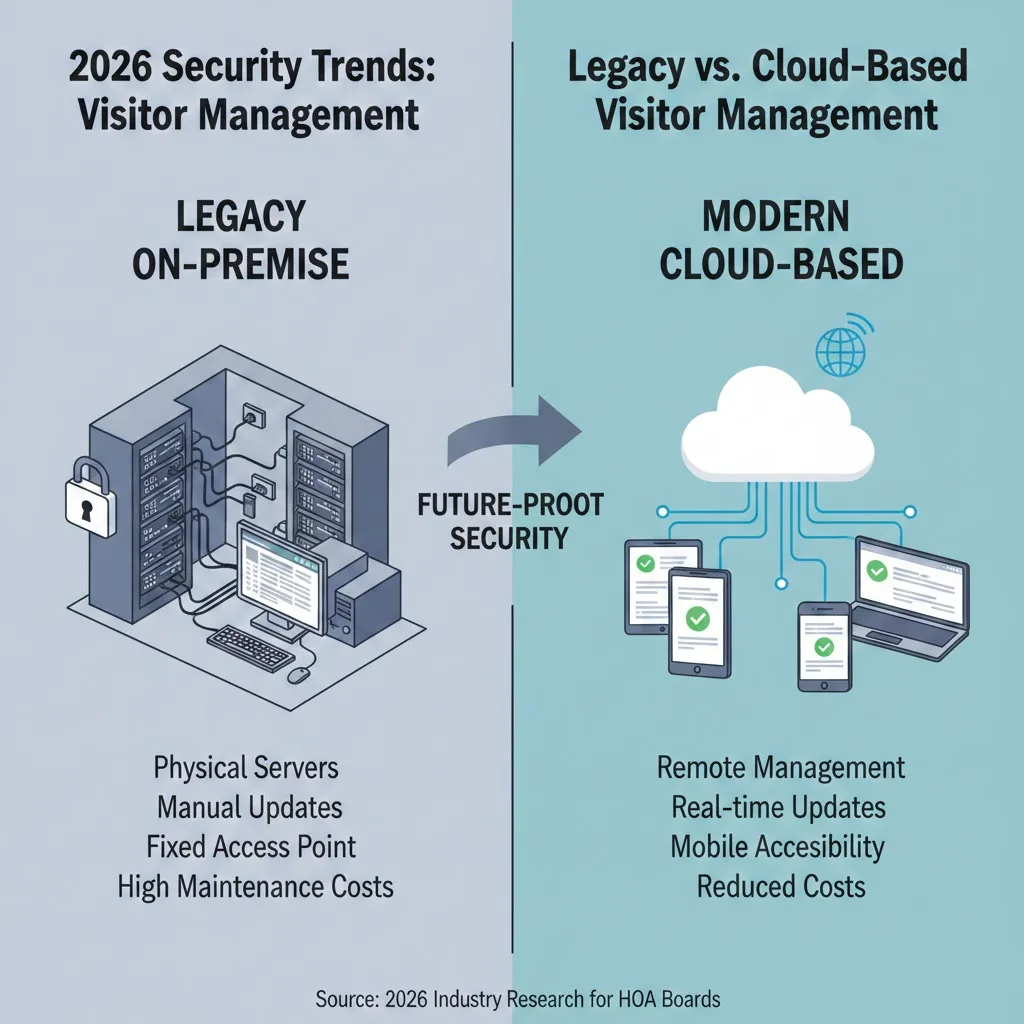
Florida HOAs are rethinking how they handle security at the gate. Across South Florida communities, from the resort-style neighborhoods of Palm Beach Gardens to the active 55+ communities near Boca Raton, the shift from old on-premise servers to cloud-based visitor management is happening fast. If your community is still running legacy hardware, this post will explain exactly why that's becoming a problem, and what you can do about it.
Ready to skip ahead? Call Entrance IQ at (561) 503-4500 to find out how quickly your community can switch.
Why Are Legacy On-Premise Systems Failing in 2026?
On-premise security systems typically fail because they can't receive real-time updates, can't be managed remotely, and cost significantly more to maintain as hardware ages. Most HOAs running legacy systems spend between $3,000 and $7,000 per year on server maintenance alone, not counting downtime during outages or the cost of emergency repairs after a system crash.
The hardware problem is only part of it. When your server lives on-site, your security data lives there too. A power outage, a flooded server room during a summer storm, or even a simple hardware failure can take your entire gate system offline. For a community managing dozens of daily visitor entries, that's not just an inconvenience. It's a liability.
Legacy systems also can't talk to modern access control hardware. Most were built in an era before mobile apps, license plate recognition, or real-time visitor logging existed. Patching those capabilities onto aging infrastructure is expensive and often unreliable.
What Are the Top 5 Benefits of Cloud-Based Visitor Management?
Cloud-based visitor management gives HOA administrators real-time control, automatic updates, and off-site data backup, all without maintaining a physical server. Here's what that looks like in practice:
1. Remote Access and Management
Your team can approve visitors, pull entry logs, or update access permissions from anywhere. No more waiting until Monday morning to fix a weekend access issue.
2. Automatic Software Updates
Cloud platforms update automatically, typically every 30 to 90 days. You don't pay for upgrades, and you don't deal with compatibility issues from outdated software.
3. Lower Long-Term Costs
Most communities switching to cloud-based community management software report reducing their annual IT and server costs by 40% to 60% within the first year. The upfront investment is lower too, since there's no server hardware to purchase or install.
4. Scalability
Adding new gates, new residents, or new features doesn't require new hardware. Cloud systems scale with your community's growth.
5. Disaster Recovery
Your visitor data is backed up off-site continuously. If your gate system goes down during a storm, your data is safe and the system can be restored quickly, usually within minutes rather than days.
We've seen communities in Palm Beach County lose weeks of visitor log data after a server failure. With cloud-based community management software, that risk is essentially eliminated.
How Does Cloud Visitor Management Connect With Access Control Systems?
Cloud-based visitor management integrates directly with modern access control hardware through secure API connections, allowing visitor logs, gate triggers, and resident approvals to sync in real time.
That means when a visitor checks in at the gate, the system logs the entry, notifies the resident, and updates the access record simultaneously. There's no manual data transfer. No time lag.
Entrance IQ's visitor management platform is built specifically for this kind of integration. Whether you're running a single-gate community or a multi-entrance development near Wellington or Delray Beach, the system adapts to your existing hardware without requiring a full infrastructure overhaul. Most communities complete the transition in under two weeks.
Modern cloud systems also support license plate recognition, QR code guest passes, and virtual guard services, all feeding into the same centralized log. That's a level of visibility that no on-premise system from five years ago can match.
Does Cloud-Based Visitor Management Meet Florida Data Privacy Requirements?
Yes. Cloud-based visitor management platforms built for HOA use should comply with Florida's data privacy statutes, including proper data storage, access controls, and audit trail documentation. But not all platforms are equal.
When evaluating any community management software, ask these three questions:
- Where is the data physically stored, and is it encrypted at rest?
- Who has administrative access to visitor records, and is that access logged?
- Does the platform produce audit trails that can be shared with board members or used in legal proceedings?
For Florida HOAs, the ability to produce a documented visitor log with timestamps is increasingly relevant. Disputes over gate access, trespassing incidents, and insurance claims all benefit from a clear, cloud-stored record that can't be altered.
Compliance also extends to resident communication. Cloud platforms that include resident portals let homeowners manage their own guest lists, reducing the administrative load on your team while keeping residents in control of their own data.
How Do You Future-Proof Your Community's Security Beyond 2026?
Future-proofing your facility means choosing cloud-based community management software that supports integrations you don't even need yet. The communities we work with that are best positioned for the next three to five years share a few common traits.
They chose platforms designed for modularity. That means new features, such as facial recognition, smart intercom systems, or automated visitor pre-screening, can be added without replacing the entire system.
They kept their infrastructure flexible. Cloud systems don't lock you into one hardware vendor, so as access control technology improves, you can adopt it on your timeline.
They also invested in staff training early. A powerful system only delivers results if your team knows how to use it. Most cloud-based platforms, including Entrance IQ, offer guided onboarding and ongoing support that on-premise vendors rarely match.
The communities that lag are those still waiting to switch until their current system completely fails. At that point, you're paying emergency rates, making rushed decisions, and potentially dealing with a security gap. Starting the transition now, when there's no crisis, gives you time to do it right.
Take the Next Step Toward a More Secure Florida Community
Cloud-based visitor management isn't a future trend for Florida HOAs. It's the current standard. Legacy on-premise systems are already struggling to meet the security and operational expectations of today's gated communities, and the gap will only widen.
The good news: switching is faster and more affordable than most administrators expect. Most communities complete their full transition in 10 to 14 days, with costs that are significantly lower than maintaining aging server infrastructure.
If you're managing a community in South Florida and want to know exactly what a switch would look like for your gates, your residents, and your budget, reach out directly to Entrance IQ at (561) 503-4500. The team works with HOAs across the region and can give you a clear picture of what's involved, with no pressure and no vague estimates.