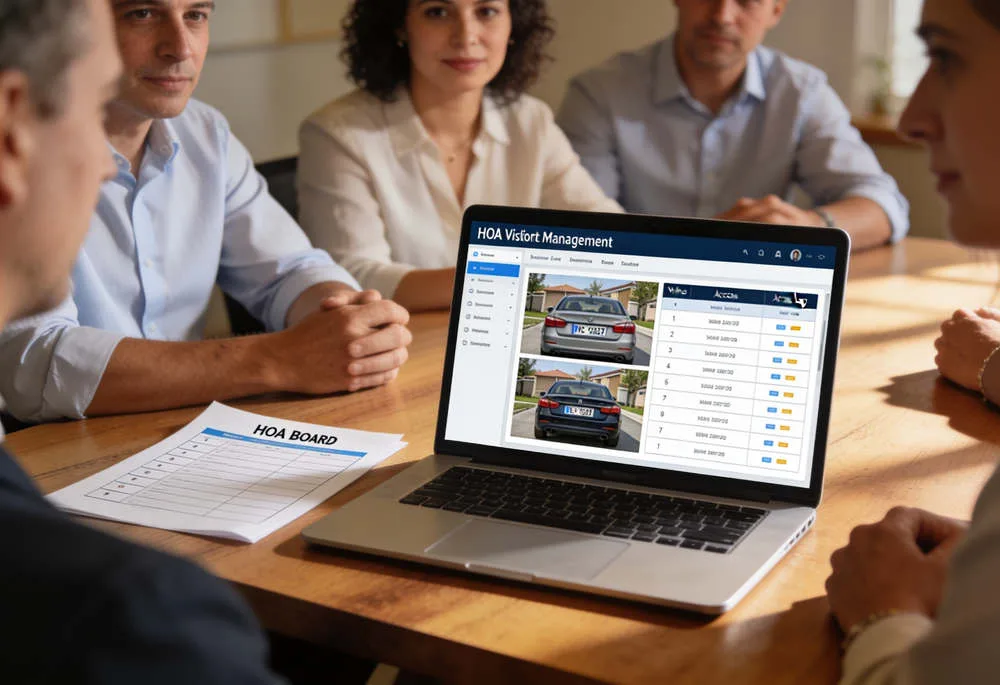
Gate security software should give HOA boards remote cloud access, license plate recognition, searchable and exportable entry logs, resident guest pre-authorization, security alerts, real-time notifications, and compatibility with existing gate hardware. For communities across Florida, each feature should solve a specific access-control risk rather than add complexity that residents and property managers will struggle to use.
Boards comparing vendors can contact Entrance IQ to review their current gate setup or call (561) 503-4500. In gated communities around Scottsdale, the important question is not how many features appear on a sales sheet. It is whether administrators can identify who entered, when the entry occurred, which vehicle was involved, and whether that access was authorized.
The same standard applies to communities around Atlanta, where a single entrance may process residents, guests, contractors, caregivers, and delivery vehicles throughout the day. Entrance IQ is built around digital accountability, giving HOA administrators and property managers a way to turn routine gate activity into useful, searchable records.
Cloud access should work from anywhere
Security problems do not wait for a property manager to sit down at an office computer. If a suspicious vehicle enters after hours or a resident reports an access issue on a weekend, authorized administrators should be able to review the system without driving to a gatehouse.
Cloud-based access removes that limitation. Board members and property managers with the appropriate permissions can review activity from a connected device, according to the platform's access controls.
The risk this removes is simple: delayed visibility. A system that can only be checked from one physical location makes it harder to respond when information is needed elsewhere.
LPR should identify the vehicle, not just a credential
Remotes, cards, and codes can be transferred. Someone can lend a remote to another driver. A gate code may be shared long after its original purpose has ended.
License Plate Recognition, commonly called LPR, connects access records to the vehicle itself. The system captures plate information when a vehicle approaches or enters, depending on the gate configuration.
That creates a more useful audit trail. After an incident, an HOA should not be left with a record showing only that "Remote 184" opened the gate. Administrators need information that can help them identify the actual vehicle associated with an entry.
For boards asking what visitor tracking features gate security software should have, vehicle capture belongs near the top of the checklist.
Entry logs need to be searchable and exportable
Recording data is not enough. Boards need to be able to find it.
Imagine a resident reports vandalism that occurred sometime between late evening and early morning. A security platform should allow authorized users to narrow the relevant time period and review associated entry records without manually watching hours of footage.
Searchability turns stored data into working information. Export capability matters too, especially when a board needs to preserve records, document an incident, or provide relevant information to law enforcement.
The risk here is buried evidence. A system may technically store activity, but if administrators cannot retrieve useful records quickly, its investigative value drops sharply.
Residents should be able to pre-authorize guests
Guest management should not depend entirely on phone calls, handwritten lists, or permanent codes passed between residents and visitors.
Resident-driven pre-authorization gives the person expecting the guest a direct role in approving the visit. The visitor arrives with authorization already in the system, which can reduce uncertainty at the entrance and create a record connecting the guest to an expected visit.
Cloud-based visitor management can make that process more consistent. Residents approve legitimate visitors before arrival, while property managers gain better documentation of guest activity.
This removes a familiar blind spot: the visitor who enters because someone says, "The resident knows I'm coming," but leaves behind no reliable authorization record.
Watchlist and person-of-interest alerts should be actionable
Some vehicles or individuals may require additional attention because of previous incidents, access restrictions, or community security concerns. A modern platform should give authorized administrators a structured way to flag relevant records according to the community's policies and applicable law.
The useful part is not merely storing a name or plate. The system should be capable of notifying the appropriate people when a flagged record triggers an event.
That closes another gap. Without automated alerts, important information may sit unnoticed in a database until someone happens to search for it.
Boards should ask vendors how watchlists are managed, who can add or remove records, what triggers a notification, and how access to sensitive information is controlled.
Real-time notifications should reach the right people
Not every gate event needs an alert. Too many notifications create noise, and noise gets ignored.
The better standard is configurable, real-time notification for events that genuinely require attention. That might include activity associated with a flagged vehicle, an unusual access event, or another condition defined by the community.
Boards should be able to understand who receives an alert and why. Property managers may need different notifications from board members or security personnel.
The risk removed here is slow response. Useful information loses value when it arrives too late.
Existing gate hardware should not require automatic replacement
A software upgrade should not begin with the assumption that every working gate component must be removed.
Many communities already have functional barriers, operators, keypads, cameras, or other access equipment. The question for a prospective vendor is whether modern visitor-management capabilities can integrate with that infrastructure.
Avoiding an unnecessary rip-and-replace project can reduce disruption and help a board focus spending on actual security gaps. Compatibility will depend on the existing equipment and site configuration, so vendors should evaluate the property rather than make broad promises before inspection.
Ask directly: What can stay? What needs to change? Why?
Take this checklist into the vendor meeting
A board evaluating gate security software should ask for clear answers on cloud access, LPR vehicle capture, searchable logs, guest pre-authorization, watchlist alerts, real-time notifications, and integration with existing equipment.
Do not settle for a feature demonstration alone. Ask the vendor to show which specific risk each capability removes. Find out what happens after an incident. Test whether records can actually be found and exported. Ask how exceptions are handled when a guest arrives in a different vehicle or an authorized administrator needs access after hours.
The software should make the gate more accountable, not merely more complicated.
If your board wants to compare this checklist against its existing entrance or see how an upgrade could work with the equipment already installed, schedule a gate review with Entrance IQ or call (561) 503-4500.