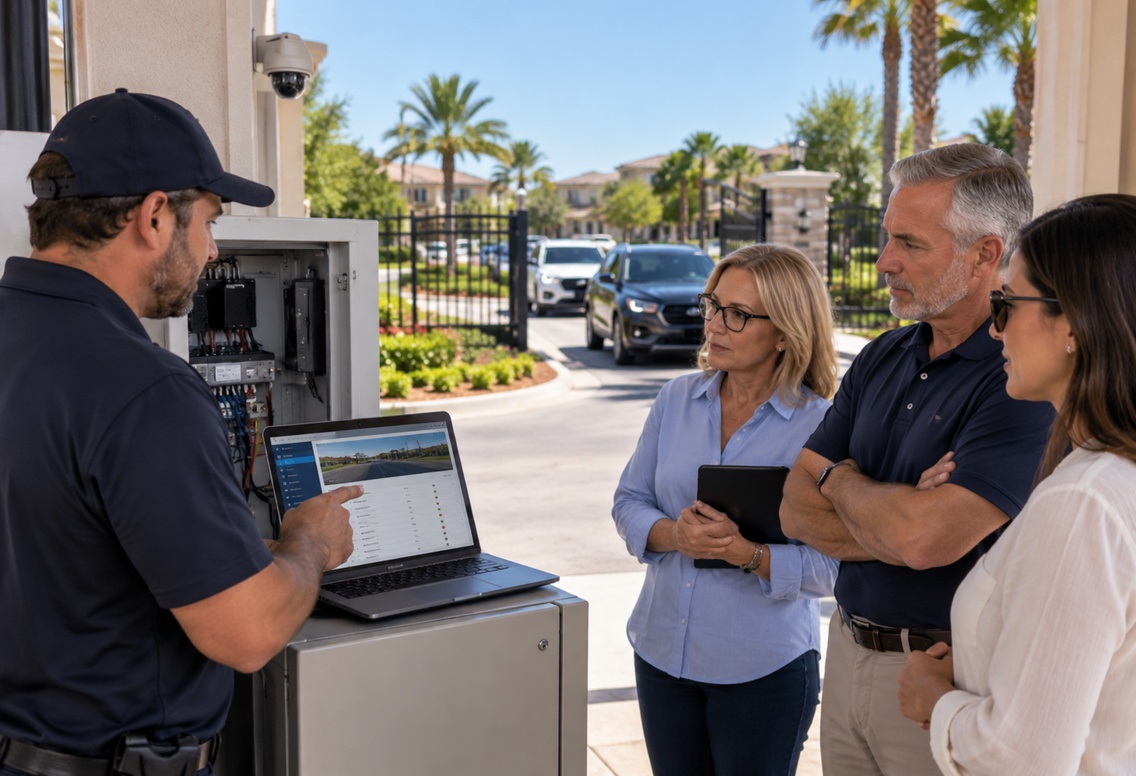
Most HOA boards that delay a gate system upgrade are not waiting on budget. They are waiting on clarity about what the migration actually involves and how confident they can be that it will not disrupt residents or lose data that took years to build. Both concerns are addressable. Entrance IQ walks boards through a migration plan before any commitment is made. Call (561) 503-4500 or schedule a scoping call online to see what the path looks like for your community.
An aging on-premise gate control system is a familiar problem for HOA boards: it works, mostly, until it does not, and the failure mode tends to be a hardware problem with no support contract and a vendor that no longer manufactures the part. The case for moving to a cloud-based system is not difficult to make on the merits. Remote administration, automatic updates, no local server to maintain, and real-time access to the entry log from any device are genuine improvements over what most legacy systems provide. The hesitation is almost always about the migration itself, not the destination. Here is what a well-structured migration actually looks like.
How Is Resident and Vehicle Data Exported and Transferred Cleanly?
The resident database is the asset the board is most concerned about protecting during a migration, and with good reason. Years of resident records, vehicle registrations, access credentials, and guest authorization history represent real administrative work that cannot simply be re-entered from scratch. Whether that data can be exported from the existing system cleanly, and in a format the new system can import accurately, is the first technical question any migration plan needs to answer.
Most legacy gate control systems store resident and vehicle data in formats that can be exported, even if the export process requires some preparation to produce a clean file. Common formats include CSV exports from the legacy database, direct SQL queries where the database is accessible, or structured text files that the legacy system can generate from its reporting function. The quality of the export depends on how consistently data was entered into the legacy system over the years, which is why a data audit before migration is more useful than discovering inconsistencies after the import has run and the new system contains duplicate records or mismatched credentials.
A clean data transfer means every resident's access profile, vehicle information, and credential assignment arrives in the new system matched to the correct record without manual reconciliation afterward. Getting there requires mapping the field structure of the legacy export to the field structure of the new system before the import runs, resolving any formatting differences between how phone numbers, license plates, or addresses were stored in the old system versus how the new one expects them, and running a verification pass after import to confirm that record counts match and a sample of individual records transferred correctly. This is preparation work, and it is the work that determines whether the migration feels clean or chaotic.
What Does Running Old and New Systems in Parallel Actually Look Like?
An HOA board that switches gate control systems with a single cutover date is taking on more risk than necessary. Parallel operation, where both the legacy system and the new cloud system are active simultaneously for a defined period, allows the board to verify that the new system is performing correctly before the legacy system is decommissioned. Residents continue to experience uninterrupted gate access during the parallel period because access is being processed by both systems, and any issue with the new system's configuration is identified and corrected while the legacy system is still the backstop.
We worked through exactly this situation with an HOA board that was replacing an outdated on-premise gate control system. Their two primary concerns were data loss and resident disruption during the transition. We developed a phased migration plan that kept their existing system operational throughout the testing period, imported their resident and vehicle data before live operation began so we could verify accuracy against the legacy records, and moved to the new system as the primary after the board had confirmed through parallel operation that everything was working correctly. No records were lost, and residents experienced no disruption during the switch. The board's anxiety about the migration was higher than the actual complexity of the process warranted, which is a common experience when the migration path is laid out clearly in advance.
The parallel period also gives the gatehouse team time to build confidence in the new system before it is the only system they are working with. Guards who have been operating the legacy system for years have habits built around that system's interface, and a parallel period where they can use the new system for actual entry processing while knowing the legacy system is available if something looks wrong is a less stressful introduction than a hard cutover with no fallback.
How Are Existing Barriers and Credentials Integrated?
Gate hardware, including barrier arms, vehicle sensors, and intercom units, is typically not replaced during a software migration unless the hardware has reached end of life independently. Cloud gate control software communicates with gate hardware through interface controllers that translate software commands into the electrical signals the hardware understands. Whether the existing hardware is compatible with a new software platform depends on the interface controller the hardware uses and whether the new platform supports that controller's protocol.
In most cases, existing gate hardware can be retained and integrated with the new cloud platform by replacing or updating the interface controller rather than the hardware itself. This is a meaningful cost consideration for a board evaluating migration, because gate hardware replacement is a significant capital expense that the software migration does not require if the hardware is functioning and compatible. A scoping conversation that evaluates the existing hardware before the migration plan is finalized gives the board an accurate picture of what the hardware integration will involve before any commitment is made.
Access credentials, including transponders, key fobs, and proximity cards assigned to residents, need to be evaluated for compatibility with the new platform's access control module. Some credential types are portable across platforms and can be reprogrammed to work with the new system without replacing the physical credential. Others are proprietary to a specific platform and require replacement when the platform changes. The credential evaluation is part of the migration scoping process, and the answer determines whether the community can retain existing credentials or whether a resident re-credentialing program needs to be budgeted as part of the migration project.
What Reliability and Remote-Access Gains Does the Cloud Deliver?
An on-premise gate control system depends on a local server that requires physical maintenance, is subject to hardware failure, and is accessible for administration only by someone at a terminal on the same network. A cloud-based gate control system runs on infrastructure maintained by the platform provider, with redundancy built into the hosting environment that most community association budgets could not replicate with local hardware, and is accessible from any device with a browser and the appropriate credentials.
Remote administration access is the operational change that HOA administrators and property managers notice most immediately after a cloud migration. The ability to add a resident, update a vehicle record, authorize a contractor entry, or review the entry log from a phone or laptop rather than from a workstation at the management office changes how gate administration fits into the workday. An after-hours situation that previously required someone to drive to the gatehouse or the management office to make a record change can be handled remotely in minutes.
Reliability in a cloud system also means automatic software updates that apply without requiring local maintenance windows or IT involvement. A legacy on-premise system that has not been updated because the update process is complicated or because the original vendor no longer supports the version in use is a system accumulating technical debt that eventually manifests as a failure. A cloud platform that updates automatically is always running current software, and the maintenance burden that would otherwise fall to the community or its management company falls to the platform provider instead.
If your HOA board is ready to understand what a migration from your current gate system to cloud-based gate control actually involves, call Entrance IQ at (561) 503-4500 or schedule a scoping call online. Our visitor management platform is designed to integrate with existing infrastructure and migrate resident data cleanly, so the board can evaluate the full picture before committing to anything.