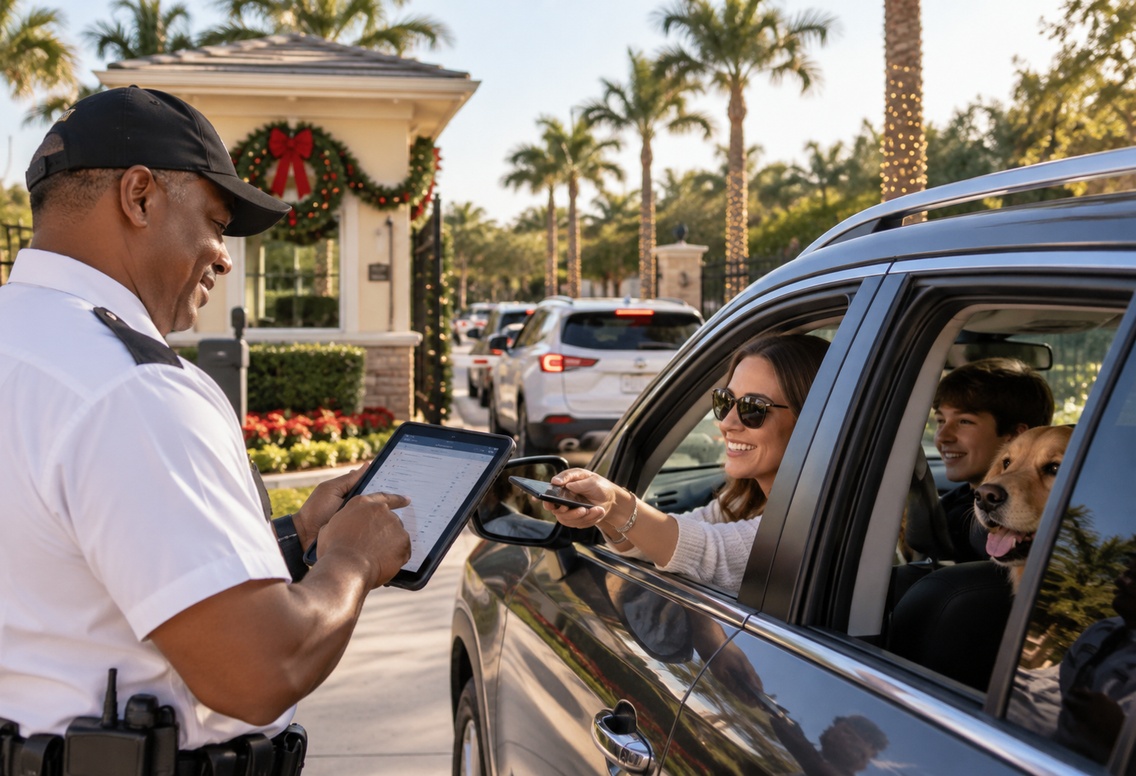
Holiday traffic at a gated community is predictable, and the chaos it produces at the gatehouse does not have to be. If your board is still relying on handwritten guest sheets and phone calls from the guard shack every December, there is a better way to run the season. Entrance IQ helps HOA administrators manage guest surges before they become gate backups. Call (561) 503-4500 or talk to our team online about getting set up before the busy season arrives.
The holidays bring a particular kind of operational pressure to HOA security that is different from the steady daily flow the gate team manages the rest of the year. Visiting relatives arrive for extended stays. Delivery volume climbs sharply as residents receive packages and gifts. Contractors and cleaning crews get scheduled before gatherings. Community events draw guests from outside the neighborhood. Each of those categories creates its own gatehouse challenge, and all of them arrive at the same time. A security operation running on handwritten lists and manual phone verifications during a surge period is not just slow. It is a backlog waiting to happen and an accountability gap that will show up in the next board meeting discussion about what went wrong.
How Do Pre-Authorized Guest Lists and Bulk Event Passes Change the Entry Experience?
Pre-authorized guest lists move the work of the holiday entry period from the guard to the resident, and they do it at a time when the resident has the information the guard needs and the guard does not. A resident who knows their daughter is arriving Thursday through Sunday with her family can enter that information into the guest management system before Thursday morning, attaching names, vehicle descriptions, and the authorized entry window. When Thursday morning arrives and the guard sees the daughter pull up, the authorization is already in the system. The guard confirms the match, opens the gate, and logs the entry in seconds. No call to the resident. No search through a handwritten sheet that may or may not be legible. No backup forming behind the vehicle while the verification process runs.
Bulk event passes address the community event version of the same problem. A holiday party that expects forty guests is not a situation that benefits from forty individual guard verifications, each requiring a search through the resident's guest list. An event pass tied to the hosting resident's address, active for a defined time window, allows the guard to verify that an arriving vehicle is there for the party and grant entry in a single step. The accountability record is preserved, the throughput is maintained, and the residents hosting the event do not have forty separate conversations with the gate about whether each guest has arrived.
Both tools shift the authorization decision to the resident at the point when the resident has the most information, which is before the guest arrives rather than when the guard is calling to confirm. That shift is where the operational improvement comes from, and it holds whether the community has a single-lane gate processing thirty vehicles a day or a multi-lane entrance processing three hundred.
How Does Software Reduce Gate Backups During High-Traffic Periods?
Gate backup during the holidays is usually not caused by the guard making decisions incorrectly. It is caused by the guard waiting for information to make a decision at all. A vehicle at the gate during a holiday surge is waiting while the guard calls a resident who may not answer, searches a handwritten sheet for a name that was spelled two different ways, or tries to reach the management office to verify an authorization that was communicated by email and never logged at the gatehouse. Each of those waits is measured in minutes, and during a busy arrival window, minutes per vehicle add up to a queue that reaches the street.
Guest management software reduces that wait by making the authorization information available at the gatehouse before the vehicle arrives. When a guard can pull up a resident's pre-authorized list in two seconds and confirm a match in another three, the decision is made and the gate is open before a queue forms behind the vehicle. The throughput improvement is not dramatic on a slow Tuesday. It is significant on the Sunday before Thanksgiving when half the community has family arriving and the other half has packages being delivered.
Delivery volume deserves specific attention as a holiday traffic category. A community that averages twenty package deliveries a day in September may see that number triple or more in December. Each delivery vehicle that requires a manual gatehouse verification process represents a lane hold. A pre-registered delivery vendor authorization, or a delivery management workflow that handles common carrier entry without a full verification for each stop, keeps delivery traffic moving without requiring the guard to treat each UPS or FedEx truck as a new unknown arrival during a period when the guard is already managing elevated traffic volume.
What Does a Searchable Digital Log Provide for Accountability?
A handwritten gate log is a record of what a guard wrote down, legible to the degree the writing was clear, searchable to the degree someone is willing to flip through pages, and available only to someone physically holding the logbook. A digital entry log in a guest management system is searchable by name, vehicle, date, time, and resident in seconds, accessible to authorized administrators remotely, and timestamped automatically rather than by a guard who may or may not have recorded the precise entry time during a busy period.
The accountability value of that log shows up most clearly when a question arises after the fact. A noise complaint, a property damage report, or a security concern that is traced to a specific date and time can be investigated by pulling the entry log for that window and identifying who was on the property during the relevant period. In a community running a handwritten log, that investigation depends on the quality of the handwriting, the completeness of what the guard recorded, and whether the log is still accessible. In a community running guest management software, the search takes minutes and the record is complete.
Board reporting is a related benefit that requires no additional work when the data is already digital. An administrator who can pull a summary of entry volume, visitor frequency, and delivery traffic for the holiday period has the information the board needs to evaluate whether current gate staffing and equipment are appropriate for the community's actual traffic patterns. That data-driven conversation is significantly more productive than a board discussion based on the guard team's general impression of how busy the holidays were.
How Do You Make the Case for Guest Management Software to the Board?
The board cost justification for guest management software comes down to two categories of benefit that most boards find straightforward to evaluate. The first is operational: reduced gate backup time, reduced guard workload during high-traffic periods, reduced phone interruptions to residents for verification calls that a pre-authorization system eliminates. These translate directly into community resident satisfaction, which is a metric boards care about because it affects the board's relationship with the membership they represent.
The second category is liability and accountability. A digital entry log that records every guest, delivery, and contractor entry with a timestamp and a linked authorization provides a level of security documentation that a handwritten log does not. In a community where a security incident or a property dispute requires documentation of who was on the property and when, that record is the difference between an answer and a gap. Boards that have been through a situation where that documentation was needed and was not available typically need no further persuasion about the value of having it.
Budget timing matters for this conversation. Software that is evaluated, approved, and implemented before the holiday surge is operational when the surge arrives. Software that is approved in January after the board discusses what went wrong in December is operational for the following year's holidays. Raising the conversation and the budget request in the fall board cycle, before the holiday period, is the timing that allows the community to benefit from the tool when the benefit is most tangible.
If your HOA board is ready to handle the next holiday surge with something better than a handwritten guest sheet, call Entrance IQ at (561) 503-4500 or reach out online. Our visitor management platform gives your gate team the tools to handle holiday volume without the chaos, and your board the accountability record that comes with every entry logged automatically.