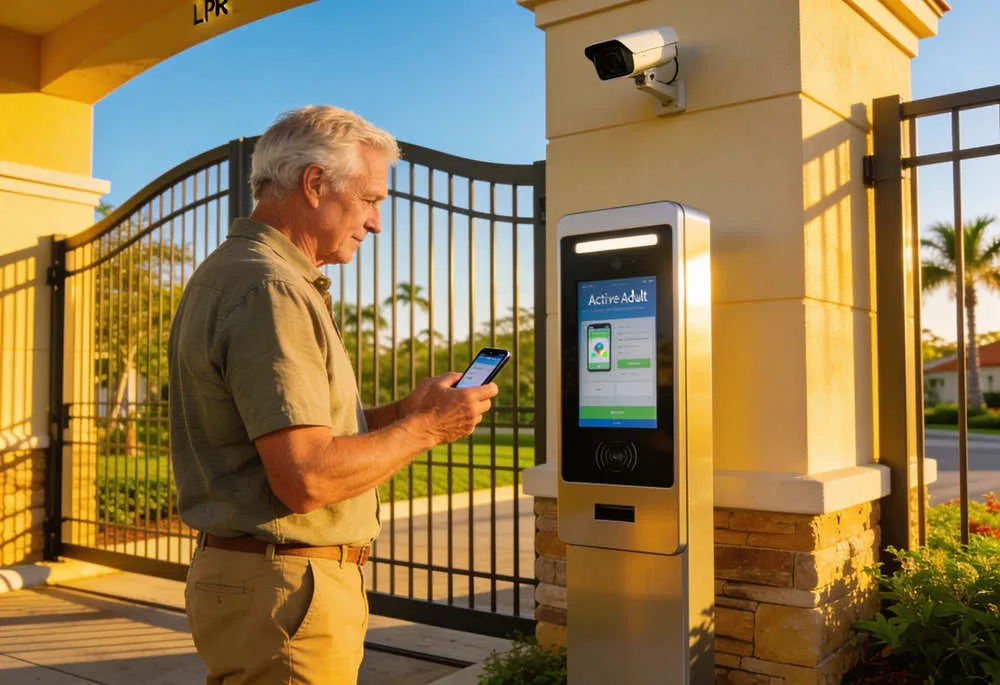
HOA and 55+ community boards can manage guest access without a guard 24/7 by combining resident pre-authorization, license plate recognition, and automatic entry logs. Instead of relying on a person to verify every visitor, the system confirms approved vehicles at arrival and records each entry. For communities across Florida, that can provide consistent gate control without carrying the full payroll cost of round-the-clock staffing.
Boards weighing security needs against operating costs can contact Entrance IQ for a gate automation demo or call (561) 503-4500. In 55+ communities around Scottsdale, the goal is not to replace personal service with complicated technology. The better test is whether residents can approve a guest easily and whether the community can verify that visit without creating a frustrating entrance process.
The same concern applies to HOA and condo communities around Atlanta, where visitors may include family members, caregivers, home health professionals, contractors, and delivery drivers. Entrance IQ adds automated access control to an existing gate, helping communities handle routine visits without depending on a guard to make every decision manually.
Why 24/7 guard staffing gets expensive
A staffed gate can provide a visible human presence. It can also become one of the larger recurring expenses in a community's security budget.
Round-the-clock coverage requires more than one employee. Communities have to account for multiple shifts, weekends, holidays, breaks, sick days, turnover, training, and replacement coverage. Costs continue every month regardless of whether the gate processes ten visitors or hundreds.
Then there is consistency.
One guard may recognize a resident's regular visitor and wave the vehicle through. Another may ask for identification. A third might rely on an outdated paper list or make a judgment call because traffic is backing up.
Those decisions are human and understandable. They are also difficult to audit later.
Automated access applies the same authorization process to each vehicle. If the guest is approved, the system can confirm the credential and record the visit. If not, the community's backup procedure takes over.
How automated visitor access works
The process should be simple enough that residents actually use it.
A resident expects a family member, friend, caregiver, or service provider. Through a mobile app, the resident pre-authorizes that guest before arrival. The visitor's information is added to the access system.
When the approved vehicle reaches the entrance, License Plate Recognition, commonly called LPR, can confirm the plate against the authorization record. The gate opens according to the community's rules, and the visit is logged automatically.
No handwritten list. No phone call to a busy guard booth. No resident waiting for someone to answer an intercom during a routine, pre-approved visit.
Cloud-based visitor management gives property managers and authorized board representatives a searchable record of gate activity. That becomes useful when someone needs to confirm when a visitor arrived, review an unusual access event, or investigate an incident.
Automation should make life easier for older residents
Technology at a 55+ community has to pass a practical test: can residents use it without needing technical support every time a guest comes over?
A good system keeps the resident's part short. Approve the visitor. Enter the necessary details. The gate handles the rest when the authorized vehicle arrives.
That matters for older residents who may regularly receive visits from adult children, healthcare providers, housekeepers, maintenance workers, or transportation services. They should not have to repeatedly explain legitimate guests to different guards or wonder whether a paper list reached the gatehouse.
There is a dignity issue for visitors, too. An invited family member should not be stuck in a growing line while someone searches for a name on a clipboard. A caregiver arriving for a scheduled appointment should have a predictable process.
Simple access is not the same as loose security. Done correctly, automation can make the experience easier while documenting more information than a manual process.
What happens when LPR cannot handle the visit?
No gate technology covers every situation. A rental car may have a different plate. A visitor may arrive in an unexpected vehicle. Weather, damaged plates, or other conditions can occasionally affect recognition.
That is why many communities use a hybrid setup.
A keypad or intercom can provide backup access for exceptions. Property management can establish procedures for rentals, temporary vehicles, emergency situations, and guests who were not pre-authorized.
The difference is that exceptions remain exceptions. The community does not need to build its entire access process around edge cases.
Most routine, authorized visits can move through an automated workflow. Staff or managers then spend their attention on the situations that genuinely require judgment.
The audit trail changes the security equation
A traditional guard log is only as complete as the person maintaining it. During a busy period, details may be abbreviated or skipped. Handwriting can be difficult to read. Paper records are not always easy to search after an incident.
Automatic entry logs work differently.
When an approved vehicle arrives, the system can document the access event without asking a guard to stop, write down details, and return to traffic management. Boards gain a clearer record of who was authorized and when the vehicle entered.
That accountability matters after theft, vandalism, unauthorized access, or a resident complaint. Instead of reconstructing events from memory, the property manager can begin with documented gate activity.
For boards asking how to manage guest access without a guard 24/7, this is an important part of the answer. Automation is not simply about reducing labor costs. It replaces inconsistent manual decisions with a process that creates a record every time the system handles an authorized visit.
Guard-gate-level control without full guard payroll
Some communities will continue to need onsite guards because of their size, risk profile, traffic patterns, or operating requirements. Others may find that paying for continuous staffing is difficult to justify when much of the guard's work involves checking routine, pre-authorized visitors.
Automated access can handle those predictable entries at a lower ongoing cost than full-time, round-the-clock staffing in many situations. The community keeps control over its entrance while residents gain a simpler way to authorize legitimate guests.
Existing gate infrastructure may not need to be discarded, either. The more useful question is whether a digital visitor-management layer can be added to the current setup, with LPR handling approved vehicles and a keypad or intercom covering exceptions.
If your board is reviewing guard costs or wants to see how automated guest access could work with the gate already in place, schedule a demo with Entrance IQ to review your current setup or call
Meta Title:
Meta Description: